
WHITE PINE PRESS
April 16, 2026
Traverse City’s Second-Hand Scene
What Was Once Stigmatized is Now a Hub for Community Connection
Minnie Bardenhagen
Editor-In-Chief
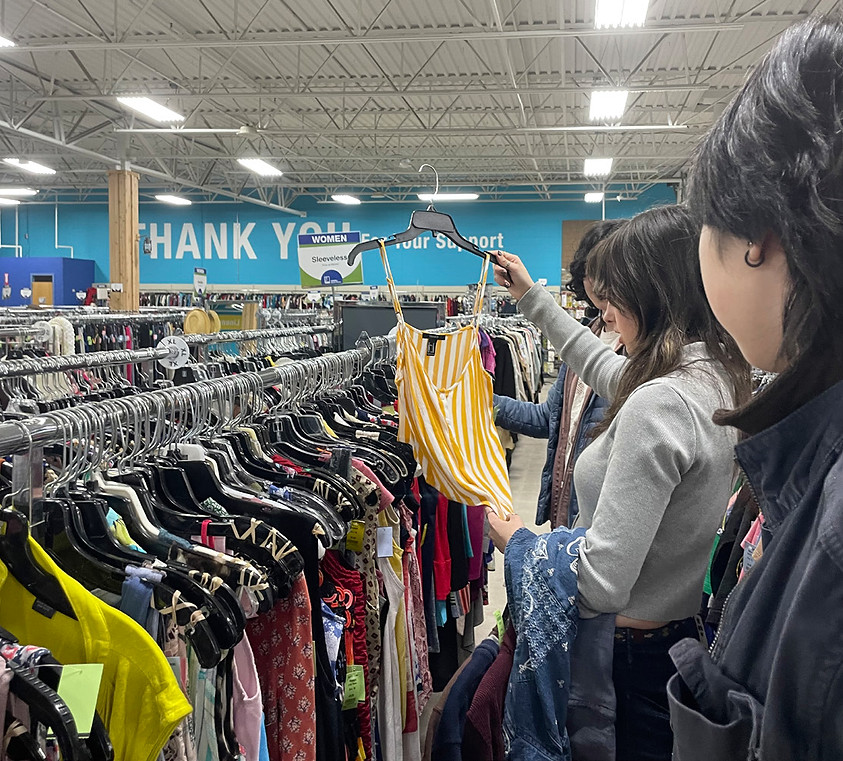
Following her typical route, Peyton LaRue made her way to Goodwill’s wall lined with shoes and various trinkets. Almost immediately, a pair of maroon shoes with white laces caught her attention. She held them to examine.
“I need those,” she said, pointing out that they were only $15, “This is why I love thrifting.”
LaRue, a second-year NMC student studying Liberal Arts, spent the evening of March 10 exploring Traverse City’s Goodwill on South Airport with two friends: Niusha Rahjoo, a first-year NMC student studying chemistry, and Faith Gantner, a third-year NMC student.
The three, all Gen Z, had all known each other before from their classes at NMC. However, their trip to Goodwill was the first time they bonded as a group.
They giggled and talked highly of each other’s fashion choices over the screeching sound of hangers being pushed around on racks and the background music playing from Goodwill’s speakers. When the store wasn’t playing hits like Olivia Dean’s “So Easy (To Fall in Love),” they made announcements, addressing shoppers as “treasure hunters.”
The three students were captured by curiosity. They pointed out the softness of slippers and crocheted scarves. At one point, they spent five minutes smelling various soaps. The word that dominated their vocabulary was “cute!”
When they saw something they thought another one of them would like, they would hold it up and call out their friend’s name. Each of them expressed that the experience had allowed them to know each other better through their styles.
“I know that you’re into skateboarding,” LaRue said, pointing at Rahjoo. Then, pointing at Gantner, she said, “I know you might play Chinese checkers.”
Rahjoo moved to the United States from Iran about two years ago.
“In my country, this donating culture, and also thrifting culture… It’s not really regular for someone to do that.”
While Rahjoo had thrifted with her family before, this was her first time doing so with friends.
LaRue has spent much of her life thrifting, citing its convenience.
“Especially because I’m a college student on a budget, it’s just a lot better for me,” LaRue said, “If you’re buying clothes that are $20 or $30 pieces, it adds up super fast.”
The appeal extends to the uniqueness of donated items.
“You can find unique items that don’t feel like they came out of a cookie cutter,” said Gantner, “I also like old things.”
Buying second-hand has been a widespread practice in the US since the Industrial Revolution, which led to increased urban populations. However, according to a TIME Magazine article titled “History of Thrift Stores” by Olivia Waxman, the practice of buying second-hand was stigmatized, mainly because it was thought of as a sign of low income.
Waxman described a slow emergence of public acceptance, starting with thrift shops earning legitimacy through affiliations with Christianity. In the early 1900s, events such as the Great Depression and World War II spurred sales at thrift stores.
Now, thrifting has taken on a significant role in the lives of US consumers. A Capital One Shopping Research report on March 6 shows that in 2025, the US second-hand market was worth $56 billion, and that 16 to 18% of Americans shop at thrift stores in their typical year. According to the report, clothes are the most purchased second-hand item, and in 2025, they accounted for 15.3% of the US apparel market. This is projected to increase to 18.8% in 2029.
As more people with stable incomes begin regularly thrifting, some critics have argued that increased demand can shut out those with lower incomes.
Carol Rose, the thrift shop manager for the Women’s Resource Center (WRC), says she does not see that being the case due to special offers for those with low incomes and the community support the shop receives.
“I remember having to do PSAs and stuff when things got low in the newspaper, saying, ‘We really need stuff’... And we would get slammed with stuff, because community support is awesome. If I ask for something, we get buried in it,” said Rose, “This store has gotten into a position where we don’t have to really do that, because we have a really strong donation base that keeps it so full.”
She explained a difference she observes between the purchasing habits of tourists and those in need.
“Summer people… they buy differently. They’re on vacation,” Rose said, “They might want to try to find that very expensive blouse that they can get for a third of the cost, it’s a little more high-end.” She said the low-income community members tend to look for items with everyday uses, such as school clothes for their children and office attire for work.
Rose has been working at the WRC for approximately 40 years. She began as a volunteer and was captured by the power behind WRC’s work to help those suffering from domestic violence.
“Women were dying. Kids were being abused,” Rose said, “I knew what the agency was doing. It was fledgling, and it was trying.”
The WRC had a humble beginning. They had one small building that housed both their thrift store and offices.
“[It was] a building where, when it rained, you had to put pots and pans out to catch the water,” said Rose. With a laugh, she said, “It was bad, and it was so much fun.”
At the beginning of WRC’s approximately 50-year existence in Traverse City, Rose said it was hard to connect with the community.
“A lot of people had a really bad idea of what we actually did… Rumor was in town that we were doing abortions in our shelter. That all the women that worked at the agency were gay, bra-burning, men-haters, all that kind of thing.”
As WRC grew into two thrift store locations, Rose watched the initial stigma surrounding the operation die out. Small moments, such as the release of “Thrift Shop” in 2012 by Macklemore, have gradually shifted the narrative. Rose remembered watching the music video, and seeing items that she would see in the WRC thrift store.
“The young kids never used to come in. In fact, if their mom got caught there, they would be embarrassed,” Rose said, “[Now] we notice the younger kids coming in buying something that’s fun and funky… I enjoy watching them out there laughing, you know, and then buying at the same time, they’re just having fun.”
She said one way you can tell the narrative has changed is from the parking lot.
“I learned how to jump a car… it [was] probably five times a week where [a] car wouldn’t start. All these little beaters would come in there, and they’d buy their little bags of clothes and stuff. Now you look out into a parking lot at any thrift shop, and you have a Hummer parked next to the beater car that’s barely going to drive, and they’re both shopping at the same store, and it’s amazing.”